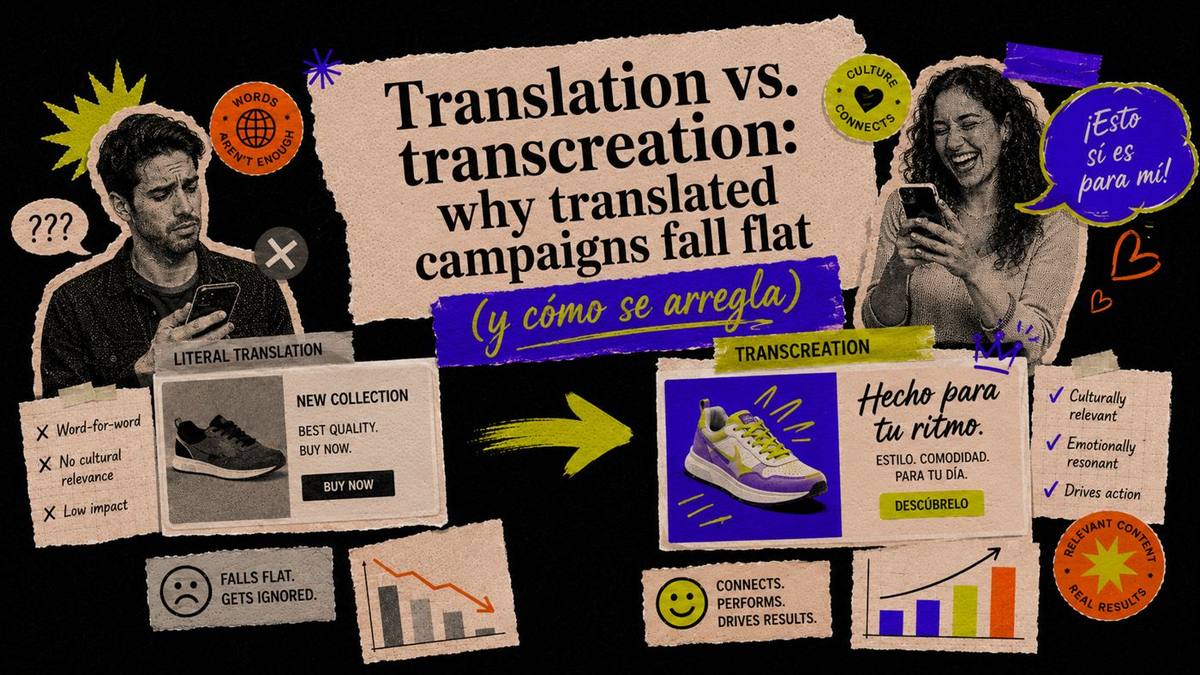
Your Spanish is correct. Your agency ran it through professional translators, maybe even a native reviewer. And still, the campaign that crushed it in English landed in the Latino market with the enthusiasm of a parking ticket. We see this every week, and the diagnosis is almost always the same: the words made the trip, the meaning stayed home.
Correct is not the same as felt
Translation optimizes for accuracy. Marketing runs on emotion. When a tagline built on an English idiom, a pop culture wink or a specific sense of humor gets converted word by word, the accuracy survives and the joke dies. U.S. Latino audiences do not read that Spanish as wrong; they read it as outsider. It signals that the brand bought a language service, not that it knows them.
Que se entienda es lo mínimo. Que se sienta es la meta.
The three ways translation quietly kills a campaign
- Register mismatch. Spanish has formal and informal voices (usted, tú, vos), and every country draws that line differently. A translated ad usually picks one register by accident and sounds stiff to half the audience.
- Reference vacuum. Your English copy leans on references your U.S. audience grew up with. Swap the words and the reference points at nothing. The audience feels the hole even when they cannot name it.
- One Spanish for twenty cultures. "Hispanic" is not one audience. A phrase that charms in Mexico City can confuse in San Juan. Generic, flattened Spanish avoids offense by also avoiding connection.
What adaptation does differently
Adaptation (transcreation, if you like the industry word) starts from the strategy, not the sentence. We ask what the campaign makes people feel in English, then rebuild that feeling in Spanish with references, humor and rhythm that belong to the audience we are talking to. Sometimes the best adaptation keeps two words from the original. Sometimes it keeps zero and performs better.
At Bicultura Lab every campaign runs through the same experiment: hipótesis (what should this audience feel), prueba (the campaign is born in both languages at once, nothing translated after the fact), and reacción (native speakers react before your audience does; if it does not land, it goes back to the lab).
The market you are leaving on the table
There are 62 million Latinos in the United States with over 3 trillion dollars in purchasing power, and most brands still greet them with word-for-word translations. That is not a risk. That is an opening. The brands that adapt instead of translate earn the loyalty the data keeps confirming: Latino consumers notice which brands get the culture, and they remember.
Translation vs transcreation: a side by side
Abstract arguments are easy to nod at, so here is the classic. When the "Got milk?" campaign needed a Spanish version, a literal pass produced "¿Tienes leche?", which in plenty of households reads uncomfortably close to "Are you lactating?". The adapted campaign dropped the joke entirely and built around family, cooking and the kitchen table, because that is where milk actually lives in Latino homes. Same strategy, different sentence, campaign saved.
That is translation vs transcreation in one move. Translation asks: what do these words say? Transcreation asks: what does this campaign do, and how do we make it do the same thing for this audience? One protects the sentence. The other protects the result. Frame the translation vs transcreation decision that way and it stops being a language question. It becomes a business question.
A mini case from the lab notebook
Picture a home services brand whose English tagline is "We've got your back." Friendly, confident, it works. The translated version, "Tenemos tu espalda," is anatomically accurate and emotionally empty; in most of Latin America it sounds like a chiropractor wrote it. The Spanish ads run for a quarter with clicks at half the English rate, and the team concludes, wrongly, that Hispanic marketing does not work for them.
Now rebuild it. The feeling behind "We've got your back" is simple: you are not alone in this, we show up. In Spanish that feeling already has a home: "Cuenta con nosotros, como cuentas con la familia." Different words, same promise, and suddenly the ad sounds like it was born in Spanish, because it was. In our experience running bilingual paid ads, adapted creative routinely beats translated creative on click-through and cost per lead, often by enough to change the channel's entire math.
How to audit a campaign before it ships
- Read it out loud to a native speaker who was not involved. Not a proofreader: a person from your actual audience. Watch their face, not their notes.
- Ask what it reminds them of. If the answer is "a commercial" or "a translated ad," you have accuracy without connection. If they laugh or finish the sentence for you, ship it.
- Check the register. Is the tú or usted a decision or an accident? Would your best customer talk to their own clients this way?
- Hunt the idioms. Every English idiom in the original needs a native replacement, not a conversion. If you cannot find one, change the line.
- Compare the metrics side by side. If Spanish creative consistently underperforms English by 30 percent or more, the language is usually the leak, not the audience.
When translation is enough (and when it never is)
To be fair to translation: it is the right tool surprisingly often. Contracts, product manuals, terms of service, support documentation, anything where precision is the whole point should be translated, carefully and professionally. Nobody wants a creative interpretation of their warranty.
The line is emotion. The moment the words exist to make someone feel something (taglines, ads, social captions, video scripts, subject lines), translation vs transcreation stops being a debate. Feelings do not survive word for word conversion; they have to be rebuilt with local materials.
And the stakes keep growing. The audience on the other side of that decision is 62 million strong and getting younger, more connected and more bicultural every year; the numbers are collected on our Hispanic market statistics page if you want the full picture. Brands that keep translating are not saving money. They are paying full price for campaigns that arrive with the flavor cooked out.
If you would rather not learn all this the expensive way, that is literally why a Hispanic marketing agency exists: to build the campaign in both languages from day one, so nothing has to make the trip.
FAQ
What is the difference between translation and transcreation?
Translation converts words from one language to another and optimizes for accuracy. Transcreation recreates the message itself, including humor, references and emotion, so the campaign works culturally. Translated ads are understood; transcreated ads are felt.
Why do translated ads perform poorly with U.S. Latino audiences?
Because word-for-word Spanish reads as outsider marketing. It usually mismatches the formality register, points at cultural references that do not exist in Spanish, and flattens twenty different Latino cultures into one generic voice.
Do I need different Spanish for different Latino audiences?
Often yes. Mexican, Caribbean and South American audiences in the U.S. use different slang, humor and references. A good adaptation decides deliberately when one neutral Spanish works and when country-level tailoring pays off.
Is transcreation more expensive than translation?
Per word, yes. Per result, almost never. Translation is cheap to produce and expensive to run, because underperforming creative burns media budget every single day. Transcreation costs more upfront and pays it back in click-through, conversion and brand recall.
Get your campaigns felt, not just understood
Send us one campaign that underperformed in Spanish. We will tell you why, free.
[ Enter the Lab ]Next from the lab notebook: Spanish-language SEO: the market your competition ignores