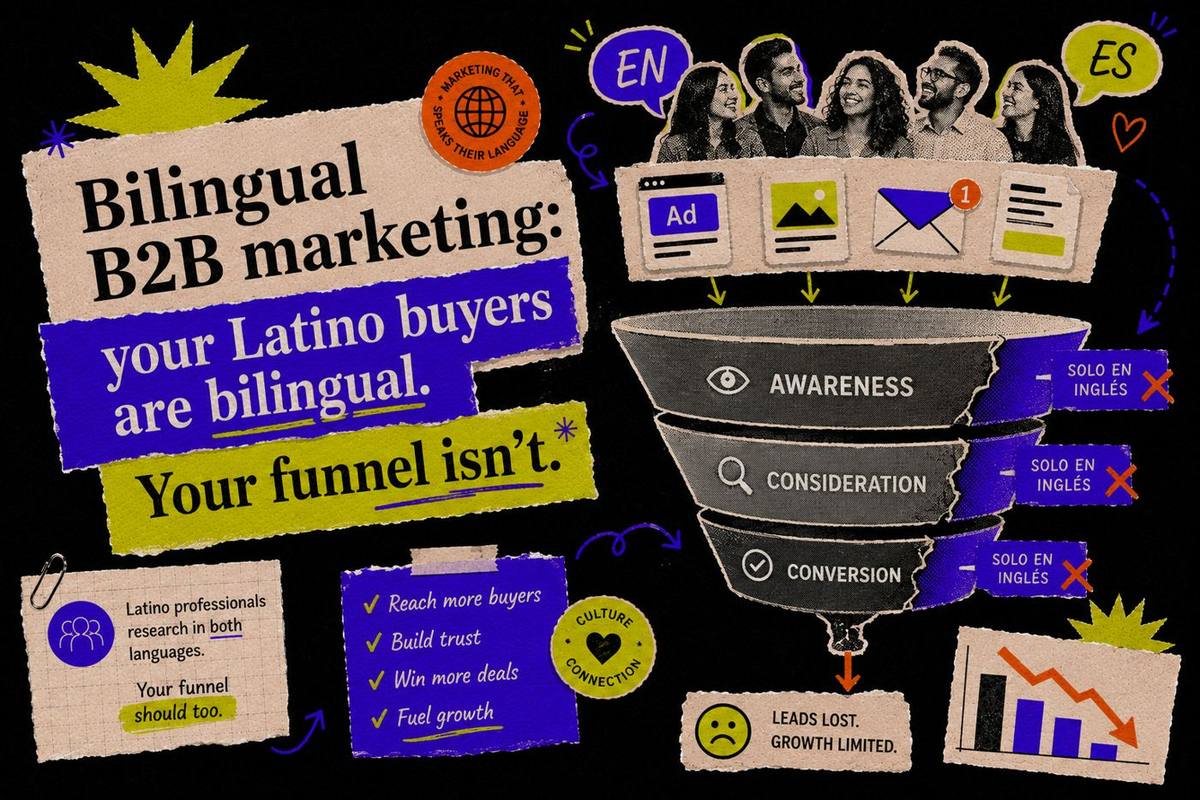
B2C brands discovered the Latino market years ago. B2B is still mostly asleep, which is strange, because Latino entrepreneurs are opening businesses at record rates and every one of those businesses buys software, insurance, equipment, banking and services. The decision makers are bilingual. The funnels trying to win them usually are not.
Where monolingual funnels leak
- Top of funnel: your ads and content run only in English, so you never enter the Spanish-language searches and feeds where many owners research. The competitor who shows up there wins the first conversation.
- Middle of funnel: the owner is comfortable in English, but the office manager, the crew chief or the family members who weigh in on big purchases may not be. One-language materials quietly lose the committee.
- Bottom of funnel: contracts, onboarding and support in English only add friction exactly where trust is decided. A WhatsApp reply en español at the right moment closes deals that emails never would.
People buy in the language they think in, even when they work in another.
What a bilingual funnel actually looks like
Not a mirrored website with everything duplicated. A bilingual funnel puts the right language at the right friction point: Spanish-language search content where discovery happens, bilingual sales collateral the buyer can forward to anyone in the decision, a sales conversation that can switch languages without breaking, and support channels (yes, WhatsApp) that meet the customer where their trust lives.
The B2B math
Latino-owned businesses are the fastest growing segment of new business formation in the country, and acquisition costs in Spanish-language channels run lower because so few B2B brands compete there. Put those together: the bilingual funnel is not a diversity gesture, it is the cheapest growth channel most B2B companies have not opened yet.
Start with one leak
You do not need to rebuild everything. Find the single point where language friction costs you most (usually discovery content or post-sale support), fix it natively, and measure. One well-placed bilingual touchpoint tends to pay for the rest of the roadmap.
A mini case: the distributor and the WhatsApp deal
Picture a restaurant equipment distributor. Their funnel is textbook: LinkedIn ads, English email nurture, a PDF catalog. Their fastest-growing prospects are Latino-owned restaurants, and those owners are not living in LinkedIn or email. They research in Facebook groups in Spanish, ask other owners on WhatsApp, and want to talk to a person before they trust a price.
The distributor makes three moves. A Spanish-language buying guide ("cómo equipar tu cocina comercial sin quemar tu presupuesto") that starts ranking for searches nobody else answers. A WhatsApp Business line answered by a bilingual rep. And one bilingual quote PDF the owner can forward to a spouse, a business partner or the cousin who co-signs the loan. Six months later the pattern is unmistakable: deals that used to stall after the first call now close, because the whole decision table can finally read the proposal.
That is bilingual B2B marketing in practice. Not a translated website. Three surgical fixes at the exact points where language was costing money.
Notice the order of operations. The distributor did not start by translating the website, hiring a Spanish-language sales team or sponsoring a festival. It started where the money was already leaking, spent almost nothing, and let the results argue for the next investment. That discipline, fix the leak before you build the monument, is what separates bilingual B2B marketing that compounds from bilingual gestures that get quietly cancelled at budget season.
The channels where bilingual B2B marketing pays first
- Search: Spanish-language queries for business services are wide open. Whoever answers "cómo conseguir financiamiento para mi negocio" owns that first conversation.
- Paid: Spanish-language campaigns on Google and Meta routinely run cheaper because so few B2B brands compete there. Our bilingual paid ads practice exists largely because of this gap.
- WhatsApp Business: in most of Latin America, WhatsApp is where business happens. That habit crossed the border; your funnel should too.
- Sales enablement: bilingual one-pagers, proposals and onboarding docs. Cheap to produce, decisive in committee-style family decisions.
- Community and events: chambers of commerce, ferias, trade groups. B2B trust in this market is still built face to face more than form fill.
Bilingual B2B marketing: the 90 day plan
- Days 1 to 30: audit the funnel for language friction. Walk every stage as a Spanish-dominant buyer would. Where do you disappear? Score each leak by the revenue at stake.
- Days 31 to 60: fix the single most expensive leak, natively. Usually discovery content or post-sale support. Build it in Spanish from scratch, no translation shortcuts.
- Days 61 to 90: measure and decide. Track leads, reply rates and close rates on the fixed touchpoint against your baseline. Let the numbers pick the second project, and put the results in front of leadership while they are fresh.
A note on sales conversations, because collateral alone does not close: the highest-leverage hire in bilingual B2B marketing is often not a marketer at all. It is the bilingual rep or account manager who can start a call in English, catch the moment the buyer relaxes into Spanish, and follow them there without missing a beat. Buyers notice that move. It says: we built this company with you in mind, not as an afterthought.
The macro case gets stronger every quarter: Latino-owned businesses are multiplying faster than any other segment, and their buying power keeps compounding (the numbers live on our Hispanic market statistics page). Every one of those businesses signs contracts for software, insurance, logistics and financing. Someone will be the vendor that spoke to them first, in the language where trust lives.
If your team does not have that native capacity in-house, it is a solvable problem: this is exactly the job of a bilingual marketing agency, and it costs far less than another year of silent losses in a market your competitors have not even noticed.
FAQ
Is bilingual marketing relevant for B2B companies?
Yes. Latino entrepreneurs are the fastest growing segment of new business owners in the U.S., and buying decisions often involve bilingual teams and families. B2B funnels that speak both languages reach buyers competitors never enter conversations with.
Do Latino business owners prefer Spanish or English?
Most move between both. In practice, discovery, trust building and support often work better in Spanish while formal documentation stays in English. Strong funnels let the buyer choose at every step.
Where should a B2B company start with bilingual marketing?
Start at the point of highest friction: usually Spanish-language discovery content (search and social) or post-sale support like WhatsApp. Fix one leak natively, measure the effect, then expand.
Does bilingual B2B marketing work for long sales cycles?
Especially well. Long cycles mean more touchpoints, more stakeholders and more chances for language friction to kill momentum. Bilingual nurture content and forwardable bilingual proposals keep every decision maker engaged for the whole ride.
Open the growth channel your competitors ignore
We map where language friction is costing you deals, and fix the leak that pays fastest.
[ Start with the audit ]Next from the lab notebook: Why translated campaigns fall flat (y cómo se arregla)