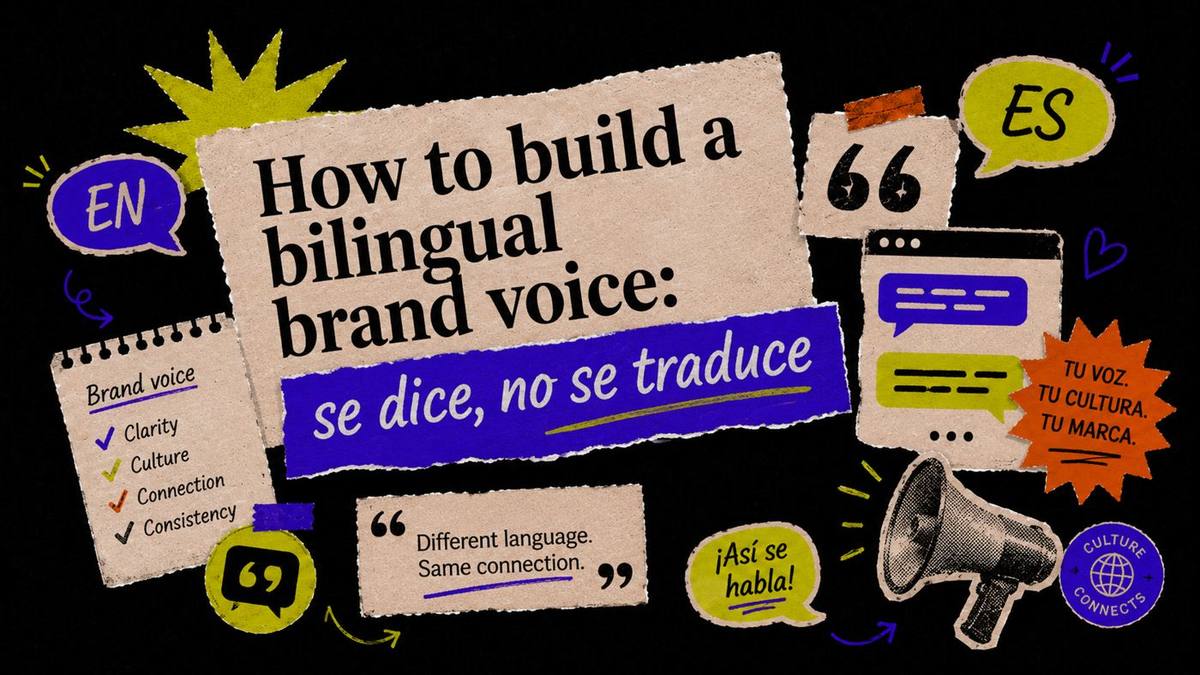
In Mexico something great is "qué padre." In Colombia your friend is your "parcero." In Venezuela, your "pana." Argentina greets you with "che," Puerto Rico goes out to "janguear," Dominicans open with "¿qué lo qué?", Cubans with "asere, ¿qué bolá?" and in Peru things get done "al toque." Eight countries, eight ways to say almost the same thing. Now ask yourself: which one does your brand speak?
Voice is a decision, not a translation
Most brands never decide. They write a voice guide in English, hand it to translators, and end up with Spanish that sounds like nobody. A bicultural voice starts with the same questions as any brand voice (how formal, how playful, how direct) but answers them twice, knowing the answers will not be symmetrical. A brand can be witty in English and warmer in Spanish, and feel perfectly coherent, because that is how bicultural people actually move between their languages.
Hablamos dos idiomas. Trabajamos en el tercero: la cultura.
Three choices that define a bicultural voice
- Register: tú, usted or vos changes the whole relationship. Pick per audience and per moment, not by default. A bank talking to first generation entrepreneurs and a snack brand talking to Gen Z should not land on the same pronoun.
- Regional flavor: generic Spanish is safe and forgettable. Regional slang is memorable, and risky if faked. The rule: use the flavor of the communities you actually serve, and only words your team uses naturally.
- Code-switching: real U.S. Latino speech flows between languages mid-sentence. Brands can earn that (a line like "marketing que suena a casa" inside English copy) but it has to sound found, not manufactured.
How you know it is working
The test is not comprehension, it is recognition. When your audience reads a line and thinks "así hablamos," you have crossed from marketing at them to speaking with them. That feeling is why adapted campaigns outperform translated ones: not because the Spanish is more correct, but because it is more theirs.
How to build a bilingual brand voice, step by step
- 1. Listen before you write. Collect the raw material: customer WhatsApp messages, reviews, social comments, how your own bilingual staff talk on the phone. Your bilingual brand voice is hiding in there already; the job is to find it, not invent it.
- 2. Decide the register, on purpose. Tú, usted or vos, per audience and per channel. Write the decision down with the reason, so the next freelancer does not undo it.
- 3. Choose your flavor sources. Which communities do you actually serve? Their expressions are your palette. Everything else is off limits, no matter how good it sounds in a brainstorm.
- 4. Set the code-switching rules. When does Spanish appear inside English copy, and how much? A ratio and a vibe ("one natural phrase per piece, never forced") beats vague intentions.
- 5. Test with recognition, not comprehension. Read lines to people from the audience. You are not asking "do you understand?" You are watching for "así hablamos."
A mini case: the credit union that stopped sounding like a form
Picture a community credit union. Its Spanish content was technically perfect and completely embalmed: "Solicite hoy mismo su tarjeta de crédito." Every sentence in usted, every word notarized. Meanwhile its members joked with tellers in Spanglish and sent voice notes asking "¿me pueden ayudar con la aplicación?"
The fix was not more translation. It was a bilingual brand voice decision: warm tú on social and email, usted preserved where money gets formal (statements, disclosures), and a short list of member expressions the brand earned the right to use. Nothing viral, nothing forced. Within a quarter, Spanish-language engagement stopped trailing English, and members started tagging the credit union in their own posts, in their own words. Recognition did what correctness never had.
Notice what happened there: not a single new translation was purchased. The credit union already had bilingual people, bilingual members and bilingual conversations happening every day. What it lacked was permission, written down, to sound like itself in Spanish. That is what a bilingual brand voice actually is: permission with rules. And once the rules existed, every writer, agency and intern could sound like the brand instead of guessing.
What goes in the voice guide
If it is not documented, it does not exist. A working bilingual brand voice guide fits in a few pages:
- The register map: tú, usted or vos by audience, channel and moment.
- The lexicon: words we say, words we never say, and the regionalisms we have earned the right to use.
- Code-switch rules: where the languages may mix and where they must not (legal, medical, pricing).
- Paired examples: five real before-and-after lines in both languages, because examples teach faster than rules.
- The referee: who has final say when a new phrase shows up, so slang gets reviewed by a person, not a deadline.
Do this once, well, and every future asset gets cheaper: briefs get shorter, reviews get faster, and freelancers stop reinventing your personality every quarter.
One more reason to take the work seriously: the audience rewarding it keeps growing. Tens of millions of bicultural consumers move between English and Spanish every day (our Hispanic market statistics page has the full picture), and they can tell instantly which brands built a voice and which ones bought a translation. A consistent bilingual brand voice is the difference they hear.
And if you want a partner who lives in that third language, la cultura: this is the core craft of a bilingual marketing agency, and the first thing we build at the lab before any campaign ships.
FAQ
What does 'se dice, no se traduce' mean for a brand?
It means the brand says things the way its audience actually says them instead of translating them. The voice is built from real usage, register and regional expression rather than converted English.
Should my brand use Spanish slang?
Only slang your audience and your team actually use. Regional expressions build recognition and affection when they are authentic, and damage trust instantly when they are faked or mismatched to the wrong community.
Can a brand sound different in English and Spanish?
Yes, and the best bicultural brands do. Bicultural people shift tone between their languages naturally, so a coherent brand can be sharper in English and warmer in Spanish while keeping the same personality and values.
What should a bilingual brand voice guide include?
Five things: a register map (tú, usted or vos by audience and channel), a lexicon of words the brand uses and avoids, code-switching rules, paired example lines in both languages, and a named owner who approves new expressions before they ship.
Want a voice your audience recognizes as theirs?
We build bilingual voice systems: register, flavor and the words your brand should never say.
[ Enter the Lab ]Next from the lab notebook: Your Latino buyers are bilingual. Your funnel isn't.
Dónde trabajamos
Todo se hace en remoto. Estas son las páginas por estado, con los datos del Censo de cada uno.